From Everest to Baggage Claim: A Deep Dive into the Base Camp Duffel
Few pieces of travel kit make the transition from expedition equipment to airport luggage as convincingly as The North Face Base Camp Duffel. Its roots lie in hardwearing bags built for demanding travel, yet today the same broad idea can be found on baggage carousels, railway platforms and weekend breaks around the world. The modern choice is no longer simply which size to buy: you also need to decide between the uncompromising classic Base Camp and the lighter, more organised Base Camp Voyager.
The quick answer: choose the Base Camp Voyager if lighter weight, internal organisation and travel-friendly compartments matter most. Choose the classic Base Camp if you prioritise tougher construction, straightforward packing and the ability to haul substantial amounts of kit. Within the Voyager range, 32L is the strongest option for light packing, 42L is the all-round short-trip choice and 62L suits longer journeys. In the classic range, Medium 71L and Large 95L are better suited to substantial loads and checked-luggage use.
From Expedition Kit to Airport Luggage
The Base Camp story predates the bag's familiar name. The North Face traces the design back to 1978, when it began as hardwearing soft luggage made from laminated vinyl. In 1986 it was strengthened for expedition use and given the Base Camp name that remains today.
That background explains why the classic Duffel still feels different from ordinary travel luggage. It was conceived around hauling equipment rather than keeping a passport, laptop and charging cable in perfectly divided compartments. Over the decades, the bag has moved from expedition logistics into mainstream travel without losing that straightforward approach.
The Voyager takes the idea in another direction. Rather than trying to replace the classic Base Camp, it adapts the concept for travellers who value lighter construction, internal division and easier organisation through airports, hotels and shorter trips.

Base Camp Voyager vs Classic Base Camp: What's the Difference?
| Feature | Base Camp Voyager | Classic Base Camp |
|---|---|---|
| Overall approach | Lighter, more travel-orientated and easier to organise | Heavy-duty, straightforward and focused on maximum durability |
| Organisation | Internal divider, mesh storage and additional external compartments | Large main compartment with simpler internal storage |
| Materials | 300D recycled polyester tarpaulin body with TPU laminate and 840D ballistic-nylon base | 1000D recycled polyester body with PVC coating and 840D ballistic-nylon base |
| Carry | Padded backpack-style shoulder straps plus grab handles | Detachable padded shoulder straps plus robust grab handles |
| Best suited to | Airports, weekends, organised packing and general travel | Heavy loads, outdoor kit, longer travel and rougher baggage handling |
Which Base Camp Voyager Size Do You Need?
The Voyager range becomes easier to understand when you stop thinking of 32L, 42L and 62L as small, medium and large versions of exactly the same use case. Each capacity suits a noticeably different style of travel.


Voyager 32L: for travelling light
The Base Camp Voyager 32L in TNF Black-Asphalt Grey is the most compact model in this guide. At approximately 57cm × 35cm × 22cm and around 910g, it is well suited to short stays, commuting, gym use and customers who deliberately keep their packing under control.
It includes padded backpack straps, an external zipped pocket, internal organisation and a laptop sleeve for devices up to 15 inches. That makes it feel closer to a hybrid travel bag than the traditional open-space expedition duffel.
Of the bags covered here, this is the strongest candidate for cabin travel. Airline rules vary considerably, however, so always compare the packed dimensions with the allowance attached to your particular airline and ticket.
View the Voyager 32LVoyager 42L: the all-rounder
The 42L is where the Voyager range becomes particularly versatile. At approximately 58cm × 37cm × 26cm and around 1055g, it provides noticeably more packing space than the 32L without moving into genuinely bulky luggage.
For a weekend away, city break or short work trip, this is likely to be the sweet spot for many travellers. The internal divider and additional pockets make it easier to separate footwear, clothing and smaller essentials instead of relying entirely on packing cubes.
You can choose between the 42L in TNF Black-Asphalt Grey and the 42L in Shady Blue-Summit Navy.
Its dimensions may work within some cabin allowances, but it should never be described as universally cabin-approved. Check the airline's current size limit before travelling.
View 42L TNF Black View 42L Shady BlueVoyager 62L: organised space for longer trips
The Base Camp Voyager 62L moves into a different category. With approximately 62 litres of capacity, dimensions of around 68cm × 41cm × 31cm and a weight of about 1280g, it gives you significantly more room for longer stays, bulkier clothing or activity kit.
The attraction is that you keep the Voyager's travel-orientated organisation rather than moving to one large undivided load space. An adjustable internal divider, mesh storage and external zipped compartments make it easier to separate items during a multi-stop journey.
At this capacity, treat it as larger travel luggage rather than assuming it can come into the aircraft cabin. It is too large for most airline cabin allowances.
View 62L TNF Black View 62L Shadow BlueWhich Classic Base Camp Size Do You Need?
The classic Base Camp makes more sense when durability and simple load space matter more than having a compartment for everything. Both sizes supplied by Allweathers are substantial bags, and both are naturally suited to heavier travel than the smaller Voyagers.
Base Camp Medium 71L: substantial without becoming enormous
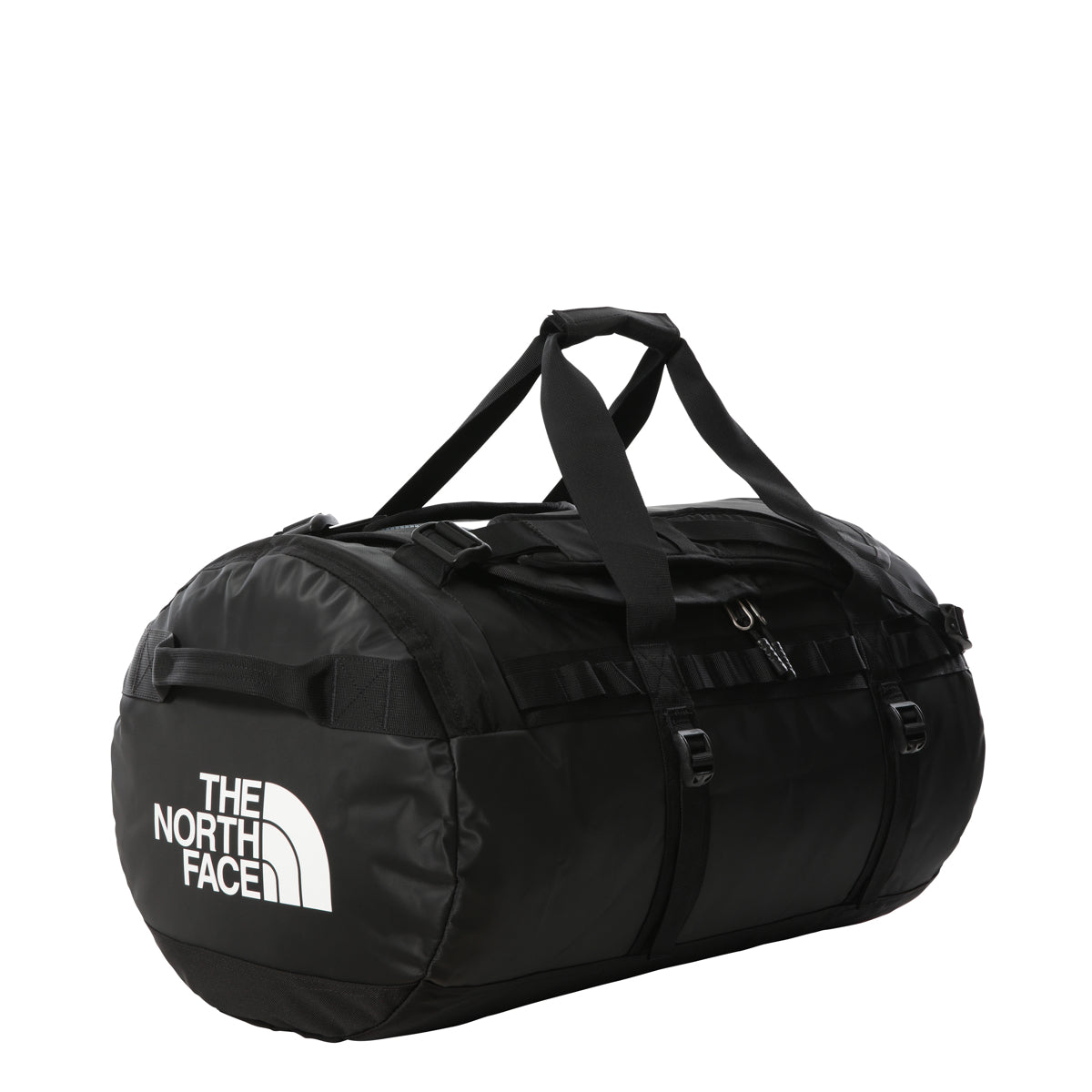
The Base Camp Duffel Medium in TNF Black has a 71-litre capacity, measures approximately 64cm × 35cm × 35cm and weighs around 1590g.
The construction is noticeably heavier than the Voyager: a 1000D recycled polyester body with a PVC coating is paired with an 840D recycled ballistic-nylon base. A large D-zip opening gives direct access to the main compartment, while compression straps help stabilise the load.
This is a strong choice for multi-day holidays, outdoor equipment or customers who simply prefer one substantial packing space. Its dimensions may exceed cabin limits, so for air travel it is safer to plan around checked baggage unless your airline explicitly allows it.
View the Base Camp MediumBase Camp Large 95L: the baggage-claim option
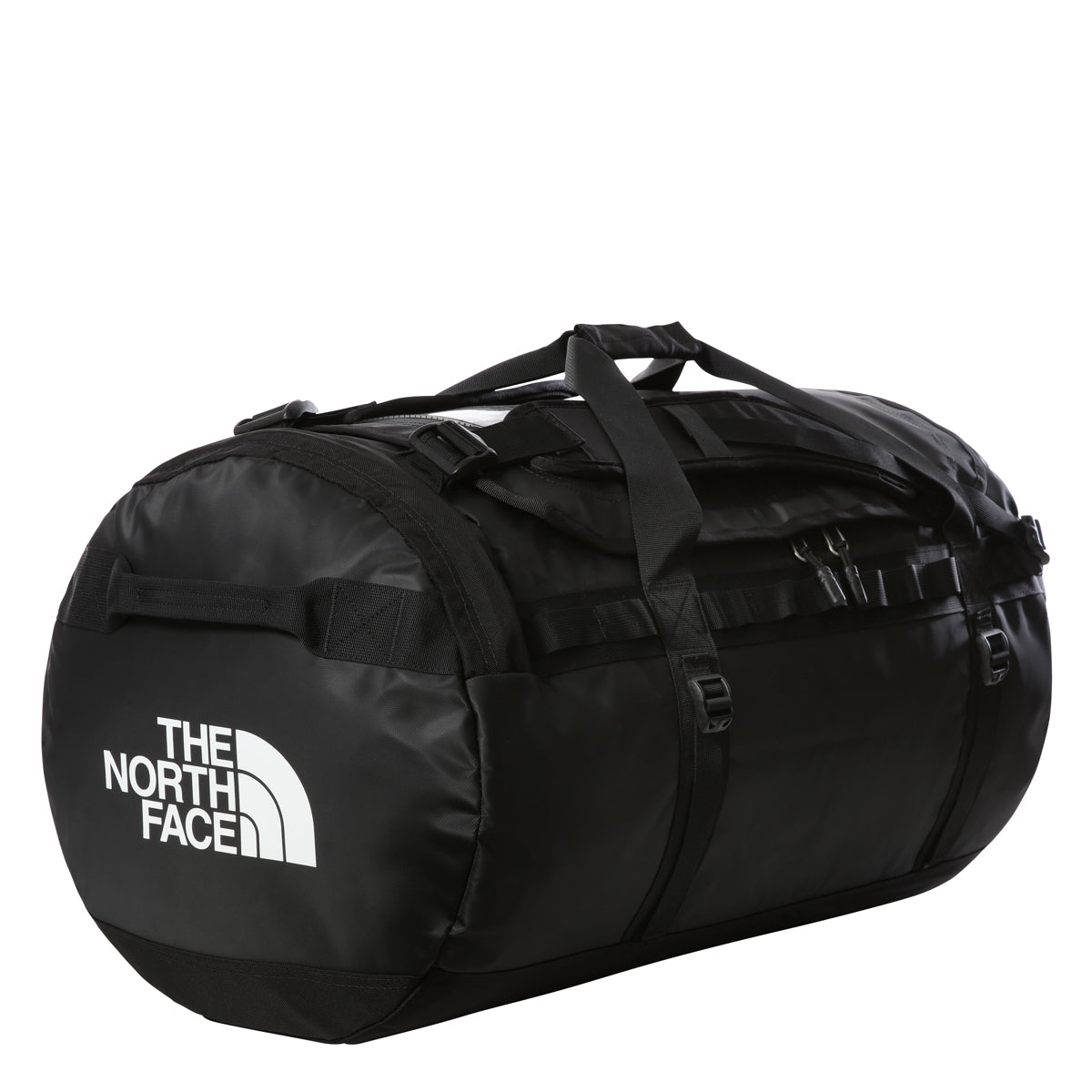
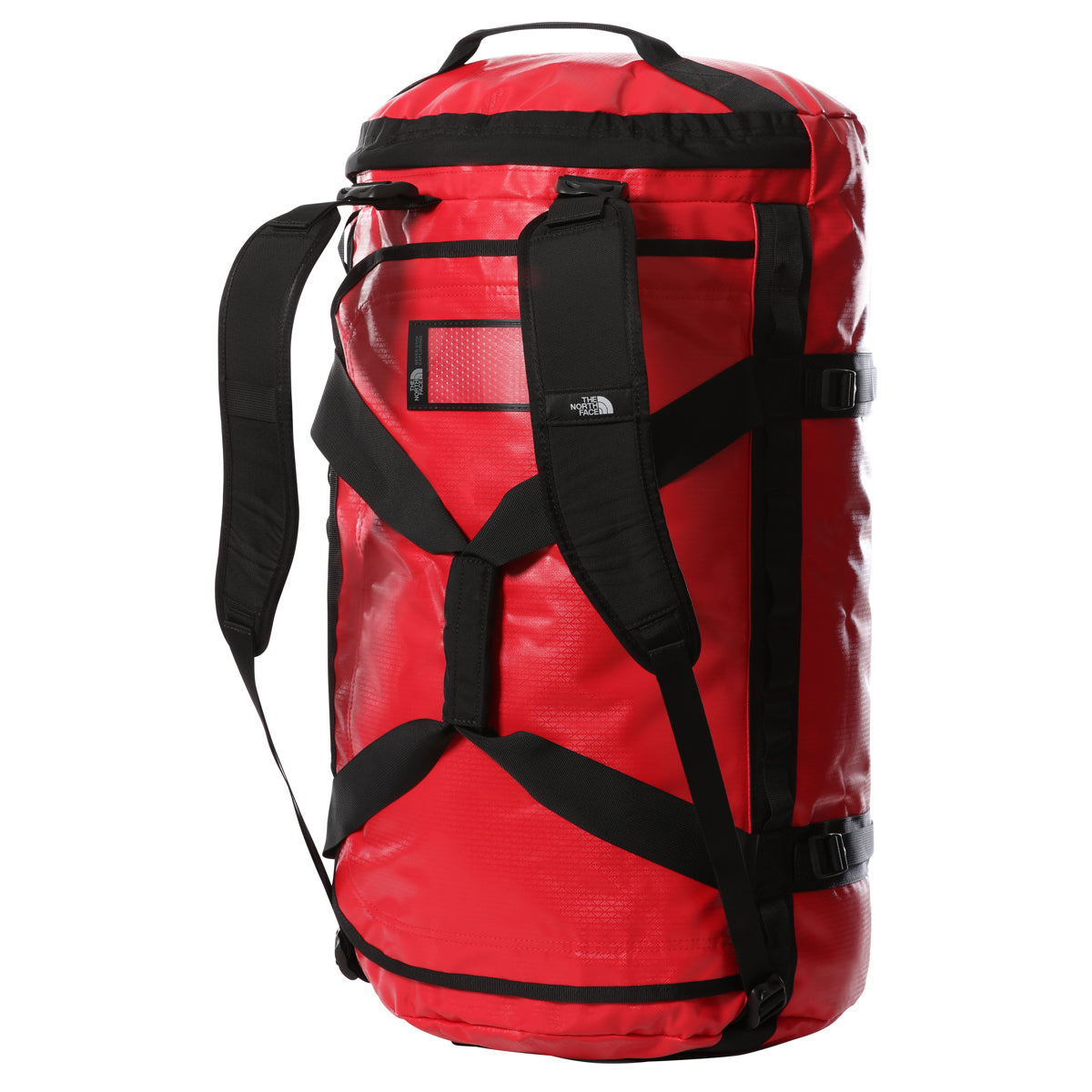
The Base Camp Duffel Large expands capacity to 95 litres, with approximate dimensions of 71cm × 40cm × 40cm and a weight of around 1840g.
This is where the classic Base Camp's expedition heritage feels most relevant to modern travel. Four compression straps help control a heavy load, while a separate zipped end compartment can isolate footwear or dirty kit from the main packing area.
For air travel, the Large belongs firmly in checked-luggage territory. If you want a bag that can take winter clothing, boots, sports equipment or enough kit for an extended trip, its straightforward volume is the main attraction.
View Large TNF Black View Large TNF RedBase Camp Duffel Size Guide
| Model | Volume | Approx. dimensions | Approx. weight | Best suited to |
|---|---|---|---|---|
| Voyager 32L | 32L | 57 × 35 × 22cm | 910g | Light packing, short trips and strongest cabin candidate in this guide |
| Voyager 42L | 42L | 58 × 37 × 26cm | 1055g | Weekends, city breaks and general short-trip travel |
| Voyager 62L | 62L | 68 × 41 × 31cm | 1280g | Longer trips, larger loads and organised travel |
| Base Camp Medium | 71L | 64 × 35 × 35cm | 1590g | Multi-day travel, substantial kit and heavier-duty use |
| Base Camp Large | 95L | 71 × 40 × 40cm | 1840g | Extended trips, bulky kit and checked luggage |
Cabin Bag or Checked Luggage?
This is where capacity alone can be misleading. Airlines normally judge cabin luggage by external dimensions and sometimes by weight, not simply by the litre figure printed on the bag.
The strongest cabin-luggage candidate here, but still check the allowance for your airline and ticket before flying.
May work within some allowances, particularly when not packed completely full, but its dimensions exceed others. Always check first.
Plan around larger luggage or checked baggage rather than assuming cabin acceptance.
Soft-sided duffels can sometimes compress more easily than rigid suitcases, but that should not be used as a reason to ignore an airline's published size rules. A bag that fits one carrier's allowance may be oversized for another.
What Are Base Camp Duffels Like to Carry?
One of the Base Camp family's most useful features is the ability to move the bag onto your back when carrying it through airports, stations or between accommodation.
The Voyager uses padded backpack-style straps designed around travel convenience, while the classic Base Camp uses detachable, adjustable shoulder straps. Both approaches are far easier than relying on a single long duffel strap when the bag becomes heavy.
There is still an important limitation. A Base Camp Duffel is a duffel that can be carried like a backpack; it is not a fully structured trekking rucksack. For long walking distances with a heavy load, a purpose-built backpack with a supportive harness and hip belt will generally be more comfortable.
Are The North Face Base Camp Duffels Waterproof?
No. Both the classic Base Camp and the standard Base Camp Voyager should be described as water-resistant rather than fully waterproof.
The coated fabrics are designed to cope with rough weather, splashes and normal travel conditions, but the construction is not intended for submersion. If you are carrying electronics or anything that absolutely must remain dry in severe conditions, use additional internal waterproof protection.
Expedition tough does not mean submersible. The standard Base Camp and Voyager bags provide useful water resistance, but The North Face distinguishes them from fully waterproof duffels that use dedicated waterproof construction.
Does Colour Matter?
Mostly, colour is personal preference, but travel can make a few practical differences worth considering.
TNF Black is understated, easy to pair with other luggage and less likely to show marks quickly. Shady or Shadow Blue gives the Voyager a softer alternative without becoming difficult to identify.
TNF Red is the standout choice. On a 95-litre Large Base Camp it is considerably easier to spot among rows of black suitcases and holdalls on a baggage carousel, which gives the colour a practical advantage as well as the classic North Face look.
The Allweathers Verdict
If you pack light and want the easiest airport-friendly option in this group, choose the Voyager 32L. If you want the best balance of useful capacity and organisation for weekends and shorter trips, the Voyager 42L is the strongest all-round choice.
Move to the Voyager 62L when you need noticeably more room but still value separated storage and travel-focused organisation.
If toughness matters more than compartments, the classic Base Camp takes over. The Medium 71L offers serious capacity without becoming enormous, while the Large 95L is the choice for extended travel, bulky equipment and checked baggage.
The distinction is ultimately straightforward: the Voyager helps you organise the journey; the classic Base Camp is built to survive it.
Shop the Base Camp Range

Written by Darren Phillips