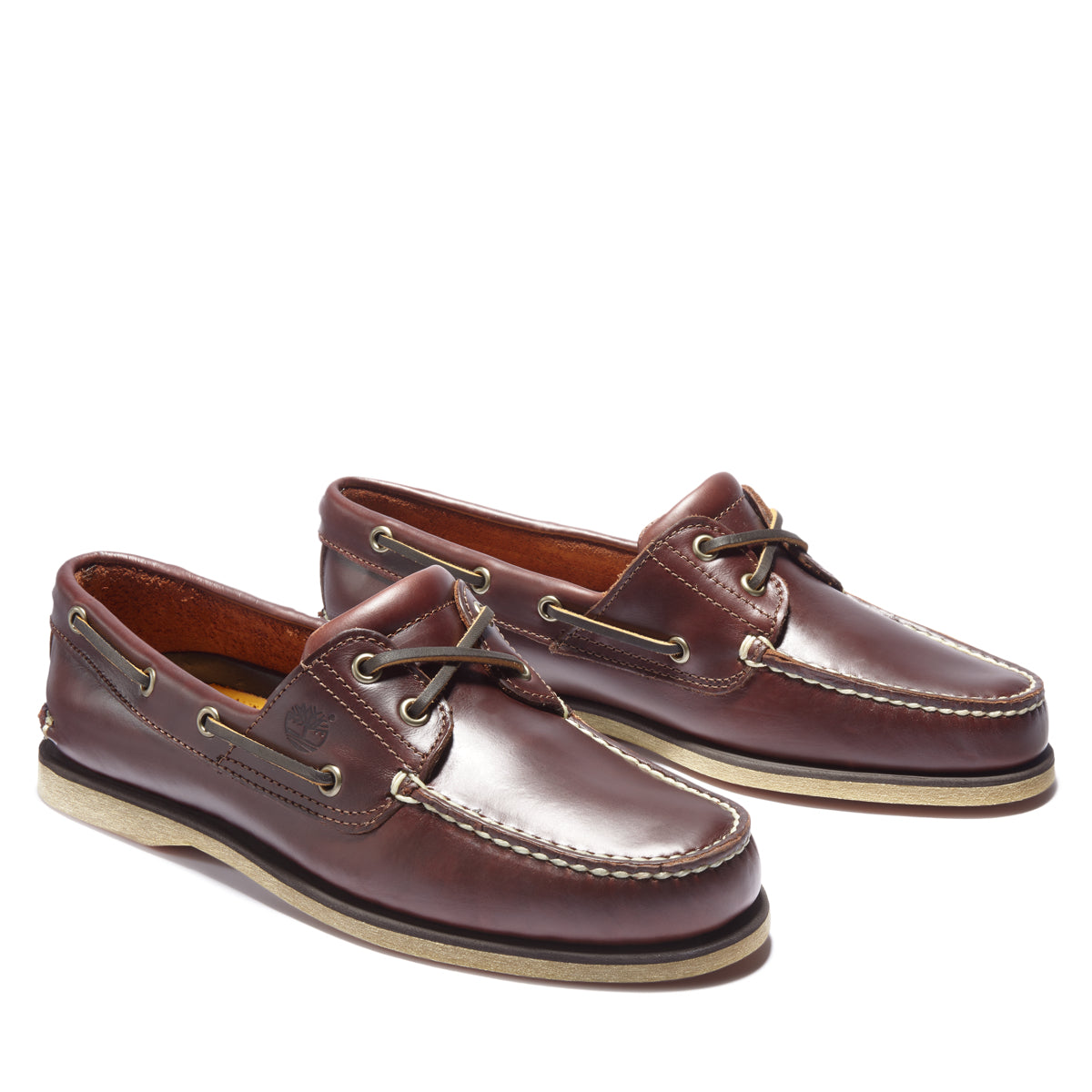
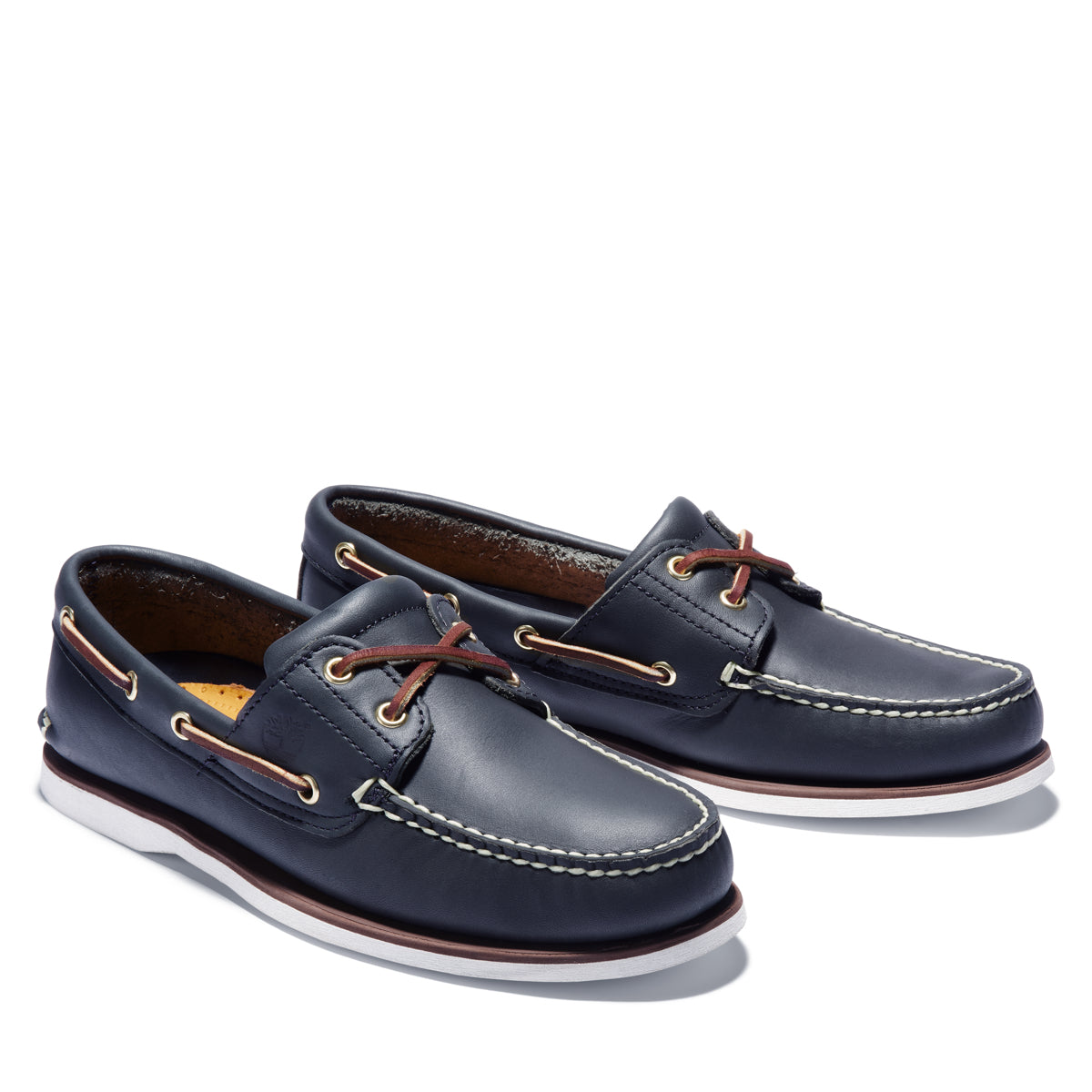
Timberland's history is about more than one boot. Its handsewn 2-Eye and rugged 3-Eye shoes show how the brand has repeatedly combined practical footwear construction with designs that found a much wider cultural audience.
Timberland's story begins long before the famous Yellow Boot. It starts with shoemaker Nathan Swartz, a New England footwear company and a practical problem: how to make leather footwear that could stand up to demanding weather without giving up comfort or everyday usefulness.
The breakthrough came with waterproof footwear construction and, in 1973, a boot carrying the Timberland name. That product became successful enough to rename the company itself. What followed was more unusual: Timberland moved from work and outdoor footwear into handsewn casual shoes, hip-hop culture, streetwear and international fashion while continuing to trade on the practical design principles that established the brand.
Nathan Swartz joined the footwear trade in the early 20th century and later took control of the Abington Shoe Company in Massachusetts. The family developed waterproof footwear-making techniques, introduced the first Timberland boot in 1973 and renamed the company after its successful product in 1978. Timberland subsequently expanded through styles including the 3-Eye Lug and Euro Hiker, while consumers gave its boots an unexpected second life in hip-hop, streetwear and global fashion.
Nathan Swartz and the Abington Shoe Company
Timberland's story is closely tied to Nathan Swartz, a shoemaker who built his career in the footwear industry before investing in the Abington Shoe Company in Massachusetts.
Swartz bought a half-interest in Abington in 1952 and took full control a few years later. His sons became involved in the business, turning it into a family-run operation focused on making durable footwear for the conditions of New England.
This setting matters. Timberland did not begin as a fashion label attempting to create a rugged image. Its identity developed around practical footwear and the problem of keeping feet protected in wet, cold and demanding conditions.
Why waterproof construction mattered
One of the key developments came in the late 1960s, when the Swartz family worked with injection-moulding technology to make waterproof footwear.
Traditional stitched footwear creates potential routes for water to enter where different parts of the shoe or boot meet. Injection moulding allowed the sole to be formed and bonded directly around the upper, helping create a more reliable barrier against the weather.
Combined with waterproof leather and careful construction, this gave Abington a practical point of difference.
The breakthrough was not simply making a heavy leather boot. It was finding a way to join leather upper and sole in a construction intended to cope with wet New England conditions more effectively.
1973: the first Timberland boot
In 1973, Abington introduced a waterproof leather boot carrying the Timberland name.
One detail is often lost in shortened versions of the story: the first Timberland boot was an eight-inch design. The six-inch version that would become the most familiar expression of the Yellow Boot followed in 1976.
The combination of waterproof construction, substantial leather and a rugged outsole made sense for people who needed practical footwear, but the design also had a visual identity strong enough to extend beyond its original purpose.
That dual role — useful first, culturally desirable later — would become a recurring theme in Timberland's history.
The boot that renamed the company
The Timberland boot became important enough that in 1978 the Abington Shoe Company adopted The Timberland Company as its name.
That is an unusual piece of brand history: Timberland was a product name before it was the company name most people recognise today.
The wheat-coloured six-inch waterproof boot subsequently became the brand's defining silhouette. What began as practical outdoor and work footwear would later be reinterpreted by completely different communities in ways the original makers could hardly have predicted.
Nathan Swartz builds his career in shoemaking and footwear manufacturing.
Swartz buys a half-interest in the Abington Shoe Company in Massachusetts.
The Swartz family takes full control of the business.
Injection-moulding techniques help the company develop waterproof leather footwear.
The first eight-inch boot carrying the Timberland name is introduced.
The six-inch version follows and develops into Timberland's best-known silhouette.
The company adopts the Timberland name and the 3-Eye Lug helps broaden the brand into rugged casual footwear.
The Euro Hiker develops the brand's lighter hiking-footwear proposition.
Timberland footwear becomes deeply connected with New York hip-hop and street style.
Timberland becomes part of VF Corporation.
1978: the 3-Eye Lug and the rise of rugged casual footwear
The Yellow Boot may dominate Timberland's public image, but the brand's history is also closely linked with handsewn shoes.
In the late 1970s Timberland combined traditional boat-shoe construction with a substantial lug outsole to create the 3-Eye Lug. Instead of keeping a deck shoe low and lightweight, the design gave it far more visual and physical weight.
The result sits somewhere between nautical footwear, a moccasin and a rugged casual shoe. Premium leather, handsewn construction and 360-degree rawhide lacing preserve familiar boat-shoe details, while the heavy rubber lug outsole gives the 3-Eye a character of its own.
This helped Timberland expand beyond boots while retaining the same principle: take a practical form and make it substantial enough for everyday life away from its original environment.
The 3-Eye in Brown and Burgundy
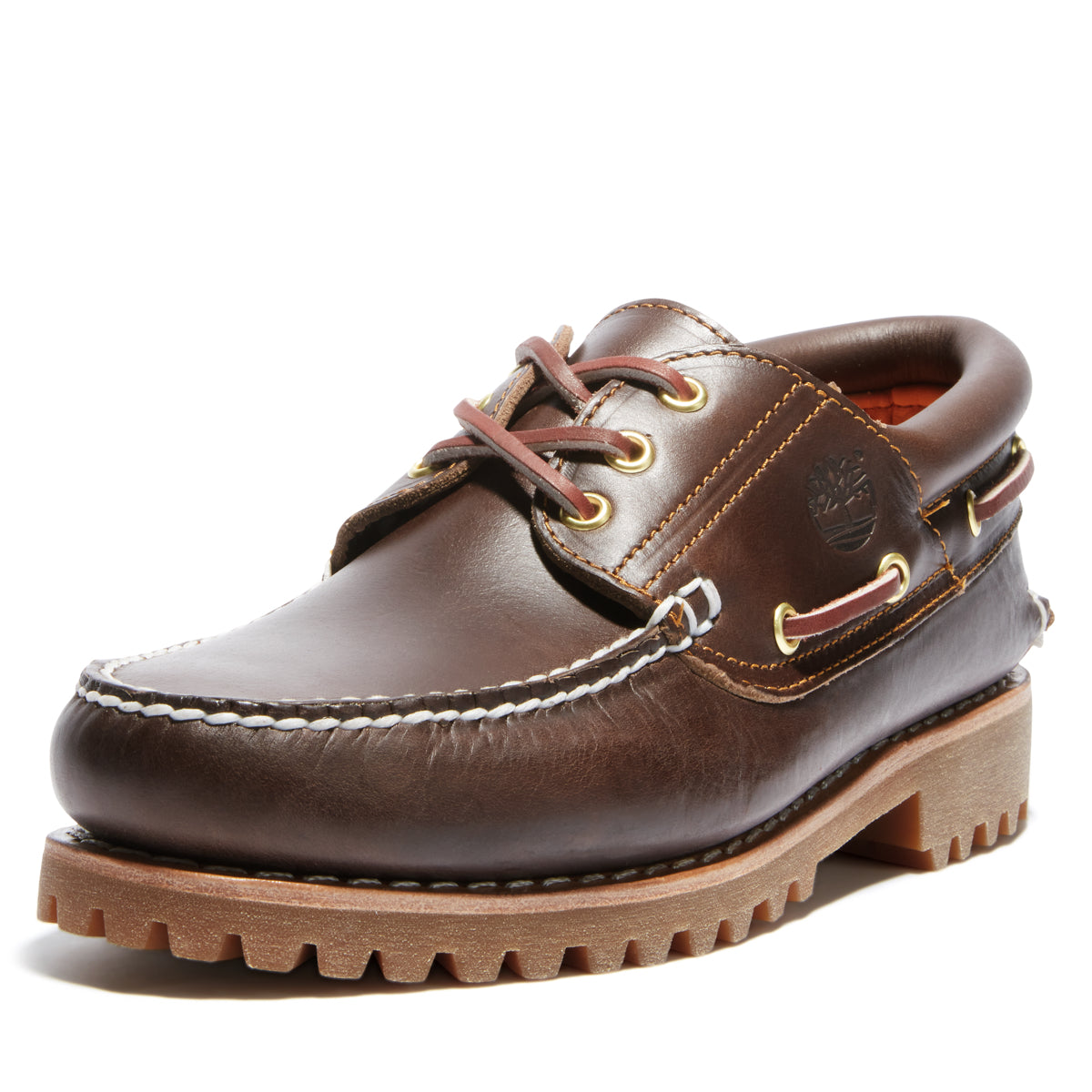
The current Timberland Authentic 3-Eye Model 30003 in Brown retains that combination of full-grain leather, handsewn construction, functional 360-degree rawhide lacing and a rugged rubber lug outsole.
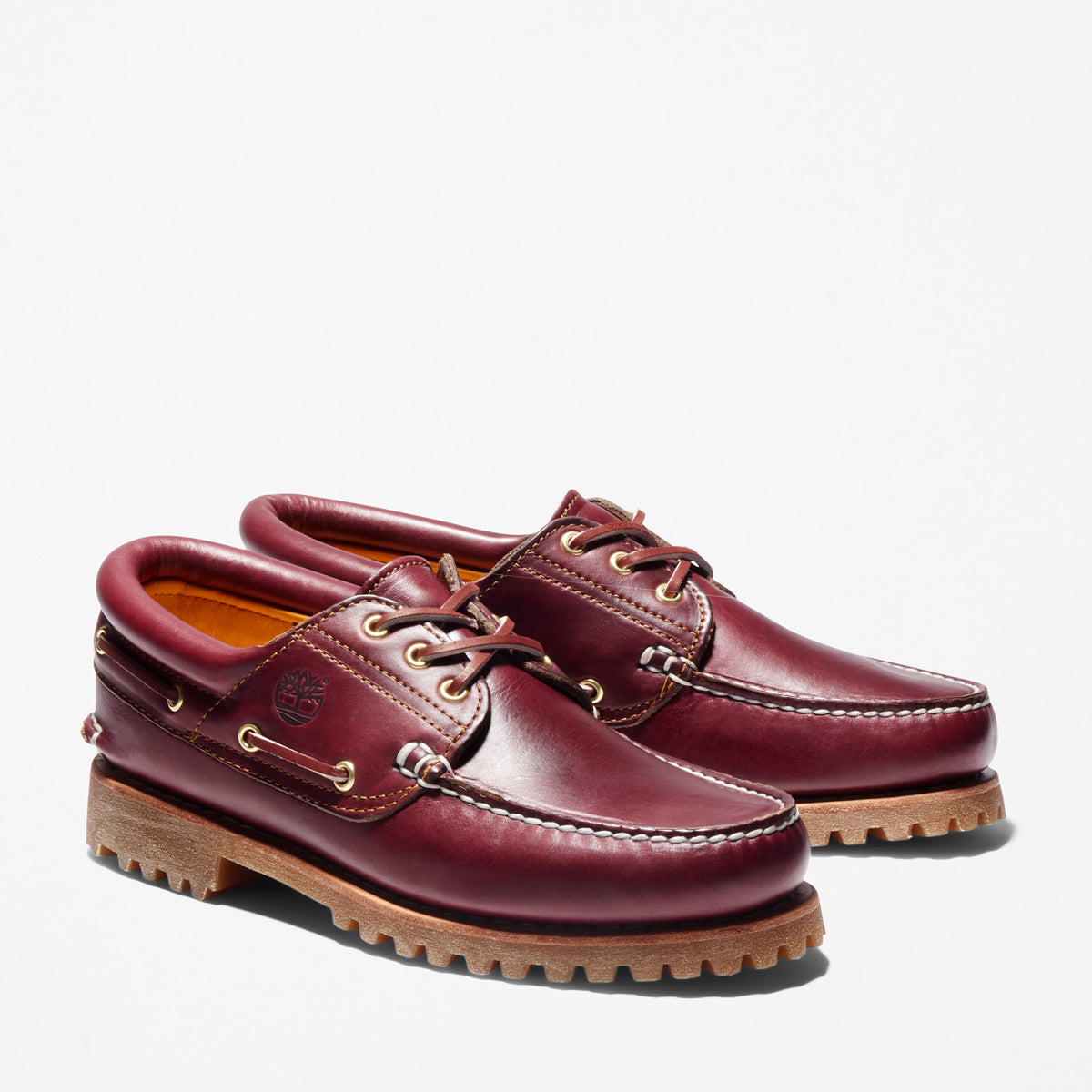
The Model 50009 in Burgundy uses the same broad heritage formula but gives it a richer colour and slightly smarter visual character.
1988: Timberland gets lighter with the Euro Hiker
The Euro Hiker, introduced in 1988, shows another side of Timberland's development.
Traditional hiking boots could be heavy, particularly when built for serious backpacking. The Euro Hiker moved towards a lighter leather hiking design suited to more everyday outdoor use and shorter walks.
It reinforced a pattern that was already becoming clear: Timberland was not confined to one waterproof boot. The brand could move between workwear, outdoor footwear and casual clothing while retaining an instantly recognisable ruggedness.
How did Timberland become part of hip-hop culture?
This is where Timberland's history becomes much more than the story of a footwear manufacturer.
During the 1980s and particularly the 1990s, Timberland boots were adopted by consumers in New York and became increasingly visible within hip-hop culture. The relationship was largely consumer-led rather than a fashion strategy invented in a boardroom.
The qualities that made the boots practical also gave them cultural presence. They were substantial, recognisable and capable of standing up to hard everyday wear. With loose denim, workwear and oversized silhouettes, the Yellow Boot looked completely at home.
Rappers and artists helped take that look far beyond New York. Timberlands became associated not just with outdoor utility but with a particular kind of urban confidence.
Timberland did not simply decide to turn a New England work boot into a hip-hop icon. Consumers gave the product a new meaning, demonstrating how authentic functional clothing can be reinterpreted far beyond the setting for which it was originally designed.
From streetwear to global fashion
Once Timberland had credibility in both outdoor clothing and street culture, it occupied an unusually broad position.
The Yellow Boot could be worn as genuine practical footwear, with denim and workwear, as part of hip-hop style or in fashion-led outfits where its heavy shape provided deliberate contrast.
That cultural flexibility eventually opened the door to collaborations and appearances across streetwear and luxury fashion.
What makes the story interesting is that the underlying product never needed to become delicate or traditionally fashionable. The ruggedness was the attraction.
That same principle can be seen today in style movements that combine traditional American outdoor and workwear pieces with much more fashion-conscious proportions. Our guide to Korean Amekaji, Barbour, Timberland and baggy trousers looks at one contemporary example.
Timberland today
Timberland became part of VF Corporation in 2011, marking another change from the family-controlled business established by the Swartz family.
Today, the range extends well beyond the original waterproof boot. Timberland produces boots, boat shoes, Chelsea boots, Chukka boots, casual footwear, clothing and accessories.
The brand also places greater emphasis on material sourcing, environmental impact and circularity than it did during its early decades. Those company-wide ambitions should not be confused with a claim that every individual Timberland product has the same environmental credentials; the specification of each product still matters.
What has remained more consistent is Timberland's preference for practical-looking products that can cross between outdoor and everyday wardrobes.
Four Timberland heritage shoes at Allweathers
The four styles below show two important strands of Timberland's footwear history: the substantial 3-Eye Lug and the cleaner Classic 2-Eye boat shoe.
Timberland #30003 – Brown
The heritage 3-Eye formula in versatile brown full-grain leather, with traditional handsewn construction, functional rawhide lacing, leather lining and the substantial lug outsole that separates it from a conventional deck shoe.
View the #30003 Timberland #50009 – Burgundy
The familiar rugged 3-Eye construction in deep Burgundy leather. A padded leather collar, leather lining and rawhide lacing sit above the chunky rubber lug outsole.
View the #50009 Timberland #25077 – Rootbeer
A cleaner expression of Timberland's handsewn heritage, with full-grain Rootbeer Smooth leather, 360-degree rawhide lacing, EVA and Poron cushioning and a low-profile siped rubber outsole.
View the #25077 Timberland #74036 – Navy
The traditional 2-Eye design in Navy Smooth full-grain leather, with handsewn construction, adjustable rawhide lacing, EVA and Poron cushioning and a siped rubber sole.
View the #740362-Eye or 3-Eye: why both matter to the Timberland story
The 2-Eye and 3-Eye make an interesting comparison because they show how Timberland can change the character of a familiar footwear idea through construction.
The Classic 2-Eye is closer to traditional deck-shoe territory: lower, cleaner and fitted with a siped rubber outsole. The 3-Eye takes handsewn boat-shoe detailing and places it on a much heavier lug sole, giving the shoe a more rugged, year-round appearance.
Neither approach is inherently better. They simply illustrate two different sides of Timberland: traditional handsewn casual footwear and the rugged reinterpretation of it.
Why has Timberland lasted?
Timberland's longevity is easier to understand when you look beyond marketing language.
Many of the brand's most important products began with a clear practical idea:
- make leather boots more suitable for wet conditions;
- combine a handsewn boat-shoe upper with a rugged lug sole;
- make hiking footwear lighter and easier to wear;
- use recognisable materials and construction rather than chasing short-lived styling.
The unexpected part of the story is what customers did with those products afterwards.
The Yellow Boot became part of hip-hop. Rugged footwear moved into streetwear. Handsewn 3-Eye shoes became as comfortable with relaxed fashion as with nautical clothing. Products designed around utility accumulated cultural meaning without completely abandoning the practical features that made them distinctive.
That is a stronger explanation of Timberland's appeal than simply calling the brand “timeless”.
Frequently asked questions about Timberland's history
When was Timberland founded?
The company history that became Timberland is rooted in the Abington Shoe Company, which Nathan Swartz invested in during 1952 and later took full control of. The Timberland product name appeared on a boot in 1973, while the company itself adopted the Timberland name in 1978.
Who founded Timberland?
Nathan Swartz is the central figure in Timberland's founding story. A shoemaker by trade, he bought into the Abington Shoe Company in Massachusetts and later brought his family into the business.
Was the first Timberland boot a six-inch boot?
No. The first boot carrying the Timberland name was an eight-inch waterproof boot introduced in 1973. The six-inch version followed in 1976 and became the silhouette most strongly associated with the brand.
Why did the company change its name to Timberland?
The Timberland boot became a defining product for the business. In 1978, the Abington Shoe Company adopted The Timberland Company name, meaning the successful product effectively gave the company its modern identity.
When did the Timberland 3-Eye appear?
The rugged handsewn 3-Eye emerged in the late 1970s. It combined traditional boat-shoe construction and 360-degree leather lacing with a substantial lug outsole, creating a style that sat between nautical footwear and a rugged casual shoe.
Why are Timberland boots associated with hip-hop?
Timberlands were widely adopted within New York street style and hip-hop during the 1980s and 1990s. Musicians helped spread the look internationally, turning practical boots into an important part of urban fashion and cultural identity.
Did Timberland create the hip-hop trend itself?
No. The cultural adoption was largely driven by consumers and artists rather than being conceived as a Timberland marketing strategy. That distinction is part of what makes the history interesting.
What is the difference between the Timberland 2-Eye and 3-Eye?
The 2-Eye is a lower-profile traditional boat shoe with a siped rubber outsole. The 3-Eye has an extra pair of eyelets and a much heavier lug outsole, giving it the rugged character for which Timberland's handsewn 3-Eye is known.
Is Timberland still a family-owned company?
No. Timberland became part of VF Corporation in 2011. The brand nevertheless continues to draw heavily on designs and construction principles established during the Swartz family's ownership.
From New England utility to global culture
Timberland's history is compelling because the brand's most influential products were not created simply to become fashion icons. Practical waterproof boots and rugged handsewn shoes found audiences far beyond their original purpose — and those customers helped redefine what Timberland meant.
Explore Timberland at Allweathers